
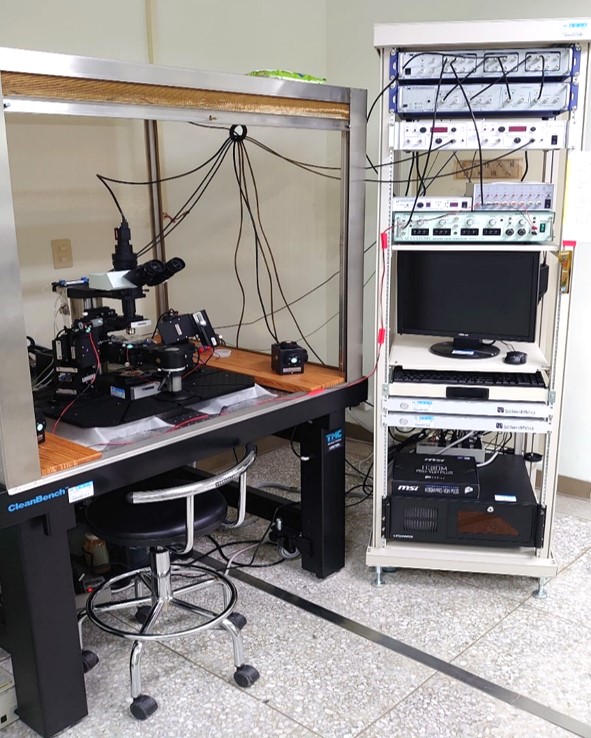
微電極細胞電訊號記錄分析系統_Physiological electrical signal
- 儀器使用規範 Terms of service
- 教育訓練影片
- 儀器收費
- 儀器預約 Booking system
- 儀器管理員:林靜慧 技術員 #1409
- 管理員信箱:

放置地點
慈濟大學勤耕樓 D921 教學研究輔助中心
儀器介紹與應用
以記錄腦薄片海馬迴興奮性突觸後電位為主,運用電流刺激以及變換各種不同的刺激條件,或是藥物處理,來誘發海馬迴突觸傳導效能之長期增益 (long-term potentiation)與長期抑制 (long-term depression) 的效應,再搭配藥理的運用,則能夠讓研究者更仔細的探討各種生理反應,或是各種藥物之機轉。
儀器規格
全自動微調操作手臂 全自動控制顯微鏡
電動微調平台 紅外線影像擷取儀
資料擷取器 資料分析軟體
快速灌流切換系統 細胞紀錄池及緩衝液灌流溫控儀
玻璃電極拉製器 滲透壓分析儀
振盪式切片機 電腦控制雙通道膜電阻回饋薄片鉗定放大器
- Attenuation of HECT-E3 ligase expression rescued memory deficits in 3xTg-AD mice
Pavithra Suresh, Sureka Jasmin, Yun Yen, Hao-Jen Hsu, Peeraporn Varinthra, Tanita Pairojana, Chien-Chang Chen and Ingrid Y. Liu
Front. Aging Neurosci., 29 July 2022 Volume 14 - 2022; https://doi.org/10.3389/fnagi.2022.916904
- Behavioral and Synaptic Phenotypes of Female Prdx6−/− Micel
Tanita Pairojana, Sarayut Phasuk, Pavithra Suresh, Ingrid Y Liu
Antioxidants (Basel). 2022 Jun 19;11(6):1201. doi: 10.3390/antiox11061201.
- Lack of the peroxiredoxin 6 gene causes impaired spatial memory and abnormal synaptic plasticity
Sarayut Phasuk, Sureka Jasmin, Tanita Pairojana, Hsueh-Kai Chang, Kai-Chi Liang & Ingrid Y. Liu
Molecular Brain; 2021 Apr 19; 14(1):72. doi: 10.1186/s13041-021-00779-6 -
The 4-(Phenylsulfanyl) butan-2-one Improves Impaired Fear Memory Retrieval and Reduces Excessive Inflammatory Response in Triple Transgenic Alzheimer's Disease Mice.
Peeraporn Varinthra, Kiruthika Ganesan, Shun-Ping Huang, Supin Chompoopong, Chatchakorn Eurtivong, Pavithra Suresh, Zhi-Hong Wen, Ingrid Y Liu
Frontiers in Aging Neuroscience; 2021 Feb 3;13:615079. doi: 10.3389/fnagi.2021.615079